

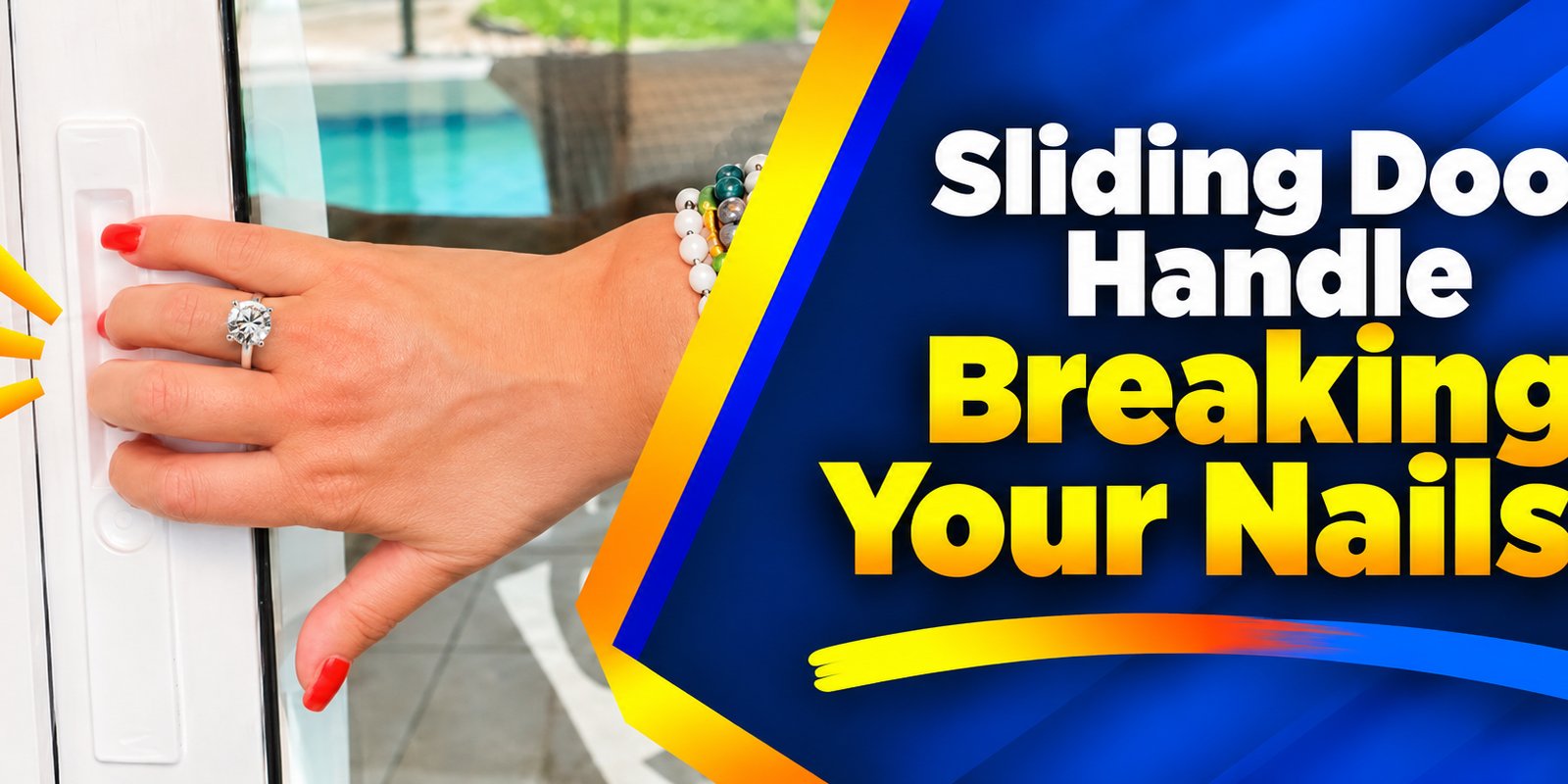

Your Fingernails Were Never Meant to Be Door Handles
There's a small moment that happens in millions of homes every day. Someone walks up to the sliding glass door, hooks two fingertips into that little recessed pull, and tugs. Sometimes it works. Sometimes a nail bends back, a fresh manicure chips, or a sore knuckle complains for the rest of the afternoon.
We hear about it constantly. And the answer is always the same: it's not your hands. It's the handle.
The Handle That Asks Your Fingertips to Do Everything
Most builder-grade sliding doors come with a small, shallow finger pull set into the frame. To use it, you press your fingertips into a narrow pocket and pull sideways. That's the entire grip.
Think about what that asks of you:
- Your nails take the contact. In a pocket that shallow, the tips of your fingers, and often the nails themselves, press against the metal edge.
- Your fingertips do all the pulling. A full hand can wrap around something and use your arm. A fingertip grip uses a fraction of that strength.
- Any resistance gets multiplied. If the door is even a little heavy or the track a little dirty, the effort goes straight into two or three fingertips.
A door you use several times a day, every day, for years, deserves better than that.
It's Not Just About Nails
Nails are the funny version of this problem. Here's the serious one.
According to the CDC, about 53.2 million U.S. adults have diagnosed arthritis, and nearly half of them are 65 or older. For someone with arthritis in their hands, a fingertip pull isn't an annoyance. It can be the reason the sliding door stays closed, and the reason the lanai or backyard gets used less.
The same design trips up:
- Grandkids, who can't get enough grip to open the door and end up pressing their hands all over the glass instead.
- Anyone carrying something: groceries, a tray of drinks, a plate headed for the grill.
- People recovering from a hand or wrist injury, for whom a pinch-and-pull motion is exactly what they've been told to avoid.
That last group matters to us, because aging in place is something most of our customers care about. AARP reports that 75% of adults 50 and older want to stay in their current homes as they age. Small, everyday friction points like this handle are part of what makes a home easier or harder to live in over time.
The Fingertip Test
Try this the next time you walk up to your sliding door.
- Open it the way you normally do. Notice which fingers are touching the handle and whether your nails make contact.
- Now push the door open by placing your palm flat on the frame edge. If the door glides easily that way, the door is fine and the handle is the problem.
- Try it with your hands full. Hold a laundry basket or a tray and try to open the door. With a recessed pull, you'll usually have to put something down first.
If the palm test was easy but the handle was a struggle, you've found your answer. If the door still fought you even with your palm, the rollers or track likely need service. That's a job for a sliding-door pro, not a new handle.
What Changes With a Full-Grip Handle
When Maria challenged Bob to fix the frustrating handles on our own sliding door, the goal was simple: a handle you hold with your whole hand, not your fingertips. That idea became the patent-pending FullGrip™ Exterior Sliding Door Handle.
Here's what's different:
- Full-hand grip. The oversized, ergonomic design lets you wrap your whole hand around it. Your nails never have to touch anything.
- More leverage, less effort. Your hand and arm do the work instead of two fingertips, so the same door feels lighter.
- Elbow-friendly. Hands full? You can open the door with your elbow.
- Kid-friendly. Children and grandkids can open and close the door on their own, which means fewer fingerprints on the glass.
- Built to last. One-piece construction, a durable powder-coated finish in multiple colors, and a Limited Lifetime Warranty.
- Non-handed design. It works on a wide variety of sliding door configurations.
It replaces the old pull entirely. It's not a clip-on grip or an adhesive add-on that loosens in the Florida heat.
"Is This Really Worth Changing?"
We get it. A handle seems like a small thing. But consider how often you use it. If you open and close your sliding door five times a day, that's more than 1,800 times a year. A small improvement on something you do 1,800 times a year adds up quickly.
And unlike most home upgrades, this one doesn't require a contractor, a permit, or a weekend. Most homeowners install FullGrip™ themselves with basic tools.
Frequently Asked Questions
Why do sliding door handles break my nails? Most builder-grade sliding doors use a shallow recessed finger pull. To open the door, your fingertips (and often your nails) press against the edge of a narrow pocket, which puts force directly on the nail.
What's the best sliding door handle for long nails or acrylics? A handle you can grip with your whole hand, so your fingertips never press into a pocket. FullGrip™ was designed around a full-hand grip for exactly this reason.
Is FullGrip™ a good option for arthritis? FullGrip™ was designed to be easier for people with limited grip strength, because it uses your whole hand and arm rather than a fingertip pinch. Everyone's needs are different, so if you have specific concerns, talk with your doctor or occupational therapist about what grip motions work best for you.
Will FullGrip™ fit my door? FullGrip™ fits many of today's most common sliding glass doors. The quickest way to know is to measure your existing handle or send us a photo. Our measurement guide walks you through it in about five minutes.
Does a better handle fix a heavy door? If the door glides when you push the frame with your palm, yes. The handle was the problem. If it still resists, the rollers or track need service, and a new handle won't fix that.
The Bottom Line
Your nails were never meant to be door handles, and your fingertips were never meant to do all the work. If your sliding door has turned into a daily pinch-and-tug, the fix is usually smaller and simpler than you'd expect.