




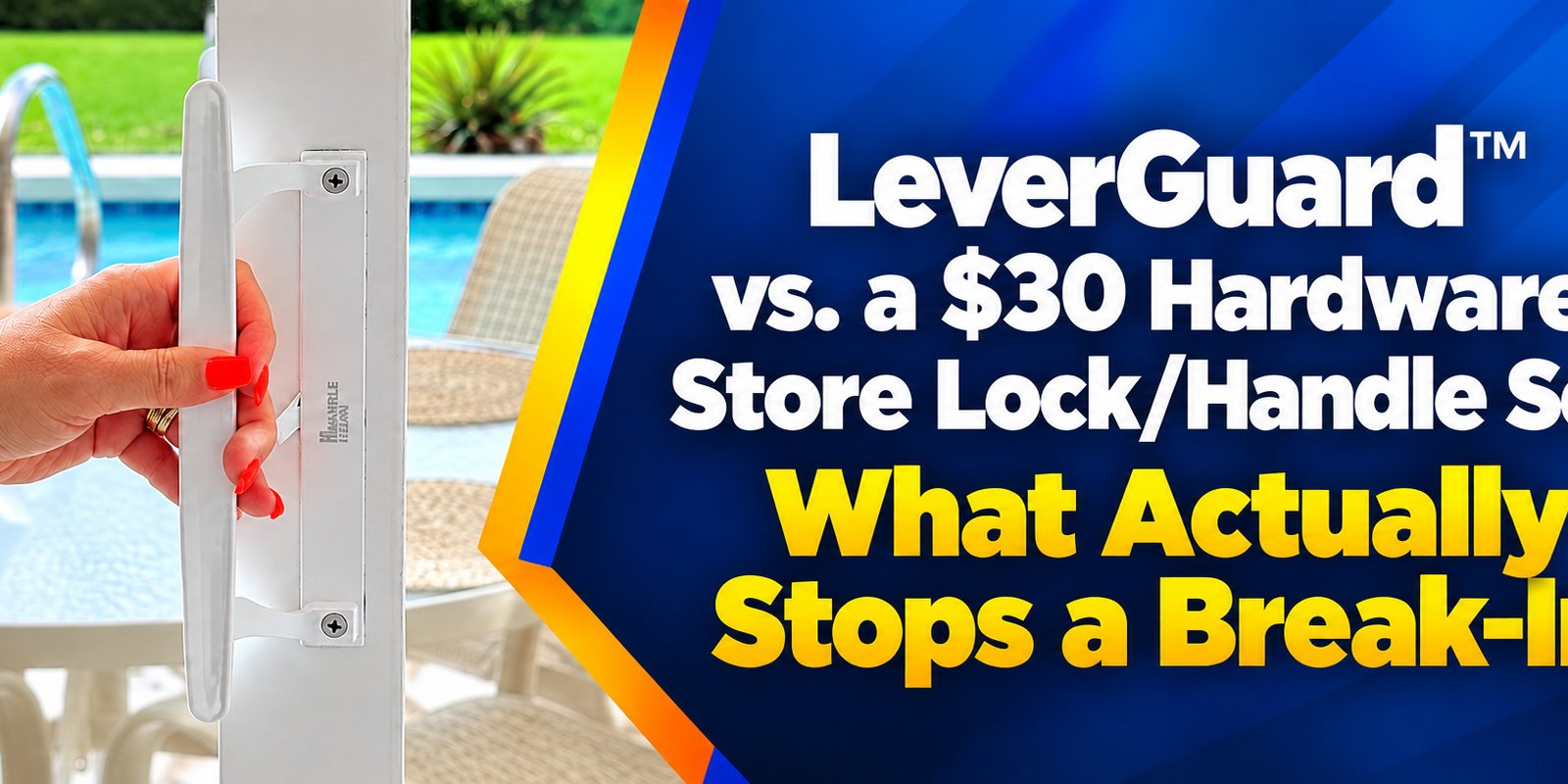

Walk into any big-box hardware store and you'll find a sliding door lock/handle set for $28–$47 — a diecast, clamp-style, non-keyed replacement that looks, at a glance, like it does the same job as anything else on the shelf (Home Depot). So why would anyone pay $129.95 for the LeverGuard™ Double Handle Kit instead?
Because they're not actually the same category of product. Here's the honest, side-by-side comparison.
What You’re Really Buying
When comparing a generic hardware-store handle set with the LeverGuard™ Double Handle Kit, it helps to understand what each includes. A generic set typically replaces only the handle, sometimes with a basic latch. The LeverGuard™ Double Handle Kit replaces the full interior and exterior handle-and-lock assembly.
The difference extends to the lock itself. Many generic sets use the same bottom-up, partially engaging hook-latch concept that has been around for decades. LeverGuard™ features a patent-pending fortified locking system engineered from the ground up, with a top-down interlock designed for full engagement.
The grip is another key difference. Traditional handles often feature a narrow, recessed finger pull. The LeverGuard™ Double Handle Kit includes a one-piece FullGrip™ ergonomic handle on both sides of the door, allowing you to use your whole hand to open and close it.
Materials and finishes also matter. Generic handles are often made from die-cast metal with an unfinished surface or basic paint. Handle-Man’s kit uses die-cast aluminum with a premium powder-coated finish.
Durability testing is rarely disclosed for generic handle sets. LeverGuard™ has been tested through more than 100,000 lock-and-unlock cycles and is backed by a Limited Lifetime Warranty. Generic alternatives may have a short manufacturer warranty or no warranty at all.
Generic handle sets are widely available through hardware stores and online marketplaces. The LeverGuard™ Double Handle Kit is available directly from Handle-Man and through its Preferred Installer network, giving homeowners access to a complete sliding door hardware upgrade.
Why the Price Gap Is the Wrong Way to Think About It
If you're comparing LeverGuard™ to a $30 lock/handle set purely on price, you're comparing it to the wrong thing. A generic hardware-store lock/handle set is a like-for-like replacement of the same weak bottom-up hook-latch lock your door already has, it might look a little newer, but it doesn't fix the underlying vulnerability. It's the equivalent of replacing a leaky faucet washer with an identical washer: functional, but not actually solving the root problem.
The more useful comparison is against a professional sliding-door repair job, where labor alone typically runs $80–$250, and a full all-in repair averages around $400 according to pricing data compiled from HomeAdvisor and local Florida installer pricing. Against that comparison, a $129.95 kit that replaces the entire handle-and-lock assembly, including parts and a DIY-friendly install, is a meaningfully better value, not a premium indulgence.
The Security Difference Isn't Cosmetic
This matters because sliding doors are a real, documented weak point: roughly 21% of residential break-ins begin through sliding doors according to FBI data cited by Boss Security Screens, and 55.7% of burglaries nationally involve forced entry per Security Lynx. A generic replacement lock/handle set with the same bottom-up latch design as the one already on your door doesn't change those odds. LeverGuard’s™'s fortified die-cast lock body and improved top-down lock engagement were specifically engineered to increase resistance to forced entry, which is the actual variable that matters in a break-in attempt, not how new the lock/handle set looks.
Where a Cheap Handle Set Actually Makes Sense
To be fair, a basic hardware-store handle isn't a bad choice in every situation. If your existing lock/handle is simply cosmetically worn, scratched, faded, a slightly different color than you'd like, and the lock itself still engages, sort of solidly, a low-cost swap can be a reasonable, minor fix. The distinction is: are you solving a cosmetic problem, or a security and usability problem? Only one of those is what LeverGuard™ is built for.
The Ergonomic Upgrade Most Comparisons Miss
There's a second gap most price comparisons skip entirely: grip. Generic replacement lock/handles sets keep the same narrow recessed finger-pull that's frustrated homeowners for decades. LeverGuard’s™'s Double Handle Kit includes Handle-Man's FullGrip™ handle on both the interior and exterior, engineered for a full-hand grip rather than a fingertip groove pinch, which matters daily, not just during a break-in attempt.
Frequently Asked Questions
Isn't a $30 handle "good enough" if I just want something that locks? It locks, but with essentially the same bottom-up latch design your current hardware already uses, so you're not meaningfully improving security, just replacing a worn part with an equivalent one. If security is the actual goal, that's the gap LeverGuard™ was built to close.
Does LeverGuard™ require professional installation? No, it's designed as a direct replacement for most standard builder-grade sliding patio door handle sets and installs with basic hand tools. Handle-Man's Preferred Installer network is available for anyone who'd rather not DIY it.
Is the price difference just because it's a "premium" brand? No, the price reflects a different product category: a full handle-and-lock replacement system with patent-pending engineering, tested durability, and a Limited Lifetime Warranty, versus a like-for-like commodity part sold at hardware stores and big-box retailers.
The Bottom Line
A $30 hardware-store lock/handle set, and the LeverGuard™ Double Handle Kit can look similar in a photo, but they're not solving the same problem. One replaces a worn part with an equivalent part. The other replaces a 60-year-old design flaw with fortified, tested, ergonomic hardware.