

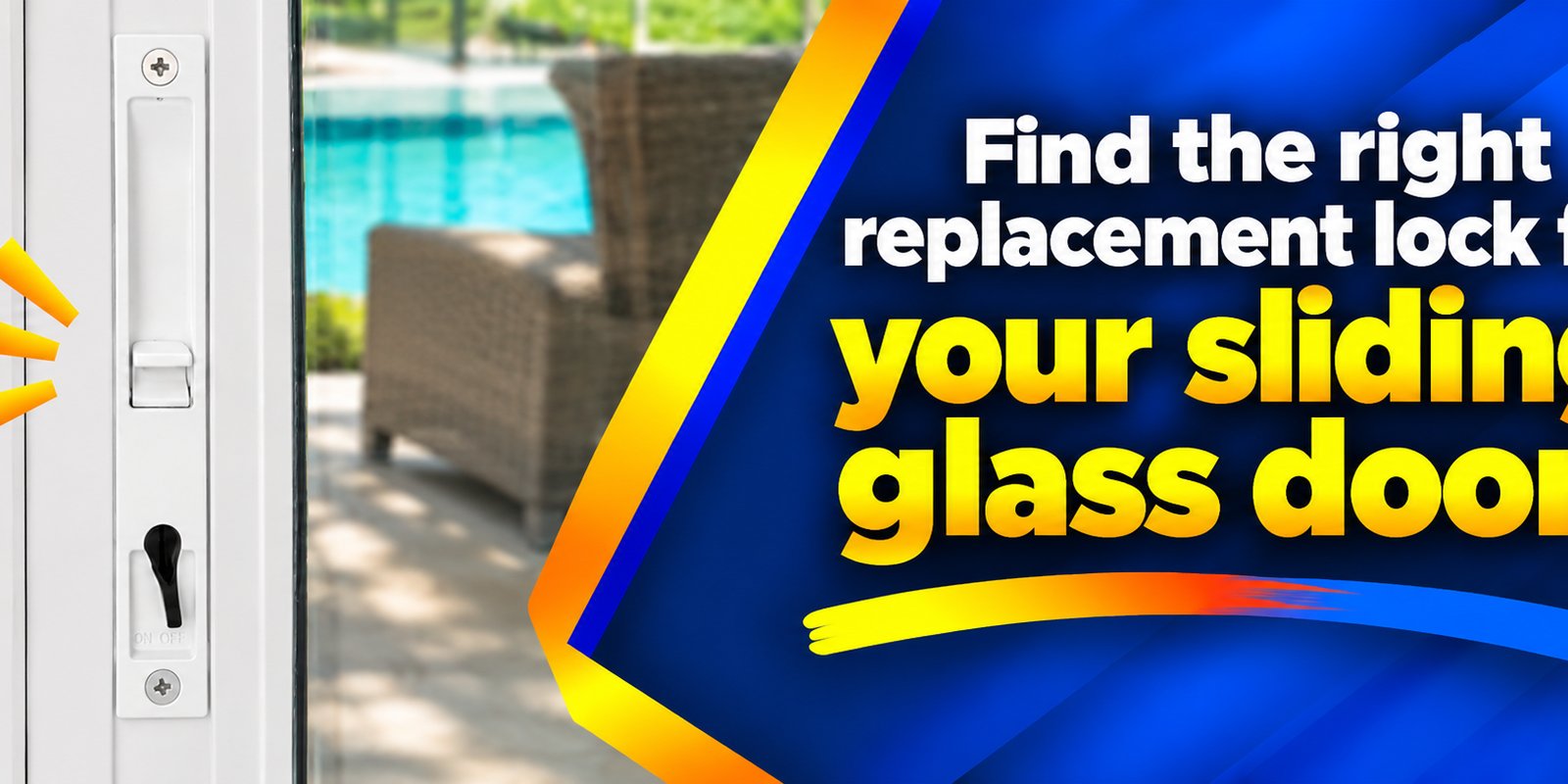

Here's a story we hear all the time. Someone's sliding door lock stops working. They pull it out, take a photo, and order the one online that looks closest. It arrives, and it's about 1/4 inch off. The screw holes don't line up, or the hook points the wrong way. Back it goes.
Sliding door locks look alike, but they aren't interchangeable. The good news is that identifying the right replacement comes down to three steps. Here's how to get it right the first time.
Step 1: Figure Out What Type of Lock You Have
Open the door and look at the edge of the moving panel, the vertical edge that meets the frame when the door closes.
Mortise lock (most common)
If you see a narrow metal faceplate on the edge of the panel with a hook that swings out when you turn the inside thumb-turn, you have a mortise lock. The lock body sits hidden inside a pocket in the door's edge, and the handles on each face operate it. Mortise locks are the most common setup on aluminum and vinyl patio sliders.
Surface-mounted latch
If the lock is mounted on the interior face of the door or frame instead of recessed into the edge, you have a surface-mounted latch. These are common on older aluminum doors and clamp onto a strike on the opposite frame.
Integrated or brand-specific handle-and-lock assembly
Many impact-rated doors, including the brands you see all over Florida, use handle-and-lock assemblies designed for that specific door line. If your door is an impact door, assume the replacement needs to be brand-specific until you've confirmed otherwise.
Keyed or non-keyed
Check whether there's a key cylinder on the outside. Keyed and non-keyed versions of the same lock aren't always interchangeable, so note which one you have.
Auxiliary locks
Foot locks, loop locks, track bars, and extra bolts add a second locking point, but they aren't your primary lock. If one of those is broken, replace that piece. If the main lock is the problem, keep reading.
Step 2: Find Out Who Made Your Door
Knowing the manufacturer narrows your options quickly. Check these places:
- The glass. Look in a lower corner of the glass panel for an etched logo or label. Tempered and impact glass is usually marked, and the mark often includes the door or glass manufacturer (Homebuild Windows).
- The frame. Look for a sticker or stamp on the frame edge, the head track, or inside the lock pocket.
- The old lock. Once it's removed, check the lock body for part numbers or brand stamps.
- The paperwork. Your closing documents, HOA records, or permit history may list the door or window brand, especially for impact doors installed after a storm.
Don't worry if you can't find a brand. Plenty of doors are unbranded or from manufacturers that no longer exist. That's what Step 3 is for.
Step 3: Take the Measurements That Decide the Match
For a mortise lock
Lowe's spells out the four features that have to match when you replace a sliding patio door mortise lock: the mounting-hole spacing, the shape of the faceplate ends, the keyway position, and the shape of the housing's rear corners (Lowe's). Here's how to check each one:
- Mounting-hole spacing, center to center. Measure from the center of the top faceplate screw to the center of the bottom one. Two common sizes are 3-11/16" and 3-15/16" (Perfect Windows & Siding). Spacing that's even 1/4 inch off won't work.
- Faceplate ends: rounded or square? Look at the top and bottom of the faceplate.
- Keyway position. The slot that the thumb-turn's tailpiece fits into sits at a specific angle when the lock is locked, usually 45 degrees or vertical. Note which one yours is (Fixing Screens).
- Rear housing corners: square or slanted? This determines whether the body fits the pocket inside your door.
While you're at it, also note:
- Hook direction. Does the hook swing up or down?
- Body width and depth. It needs to fit the pocket.
- Door thickness at the edge where the lock sits.
For a surface-mounted latch
Measure the center-to-center spacing of the mounting screws and the door thickness, and photograph both the latch and the strike plate.
For the handles that operate the lock
If you're replacing the handles along with the lock, take the handle measurements in our five-minute measurement guide (screw spacing, panel thickness, handle height, and screen clearance).
Step 4: Decide Whether to Match It or Upgrade It
Once you know what you have, you have a choice.
Match it exactly. A like-for-like lock gets the door working again. It also gives you the same design that just failed. For most builder-grade doors, that means the same basic latch concept that's been used for nearly 60 years.
Upgrade the whole lock assembly. If you're already taking the lock and handles off, this is the cheapest moment to upgrade. The LeverGuard™ Lock System was designed specifically for builder-grade sliding glass doors. It replaces the handle-and-lock assembly with a fortified, die-cast aluminum lock body, improved lock engagement, and a one-touch lever, tested through 100,000+ lock/unlock cycles and backed by a Limited Lifetime Warranty.
Stay brand-specific for impact doors. If you have an impact-rated door, use hardware made for that door line. In addition to the products we designed, we sell brand-specific options, including PGT WinGuard and SIW impact handles and a Lawson-style handle, on our shop page. The "See Your Door" tool there lets you match your current hardware to the right option.
The Easiest Way: Send Us a Photo
If all of this sounds like more than you want to deal with, here's the shortcut. Take three photos and send them to us:
- The edge of the door with the faceplate and hook visible.
- The interior handle, straight on.
- The exterior handle, straight on.
Add the screw-spacing measurement if you can. Call or text (941) 875-8932, or email info@handleman.net. We'll tell you exactly what fits. If nothing we make or sell is right for your door, we'll tell you that too.
Frequently Asked Questions
Are sliding glass door locks universal? No. Mounting-hole spacing, faceplate shape, keyway position, hook direction, and body size all vary by manufacturer and model year. That's why matching on measurements works better than matching on looks.
Do I have to remove the old lock to identify it? For a mortise lock, removing it is the best way to confirm the body shape and rear corners. You can usually measure the faceplate screw spacing with the lock still in place.
What if I can't find the door brand? That's very common. Measurements and photos are usually enough to identify the right replacement, even for unbranded or discontinued doors.
Can I put a different style of lock on my door? Sometimes. A full handle-and-lock system like LeverGuard™ replaces the whole assembly on many builder-grade sliding doors. Impact doors generally need hardware made for that door line.
Should I replace the handles at the same time? If the handles are worn, loose, or hard to grip, yes. The labor is the same, and the LeverGuard™ Double Handle Kit includes FullGrip™ handles on both sides.
The Bottom Line
The right replacement lock comes down to three things: what type of lock you have, who made the door, and a handful of measurements. Get those right and you'll order once.
And if you'd rather not measure at all, send us three photos. That's what we're here for.