


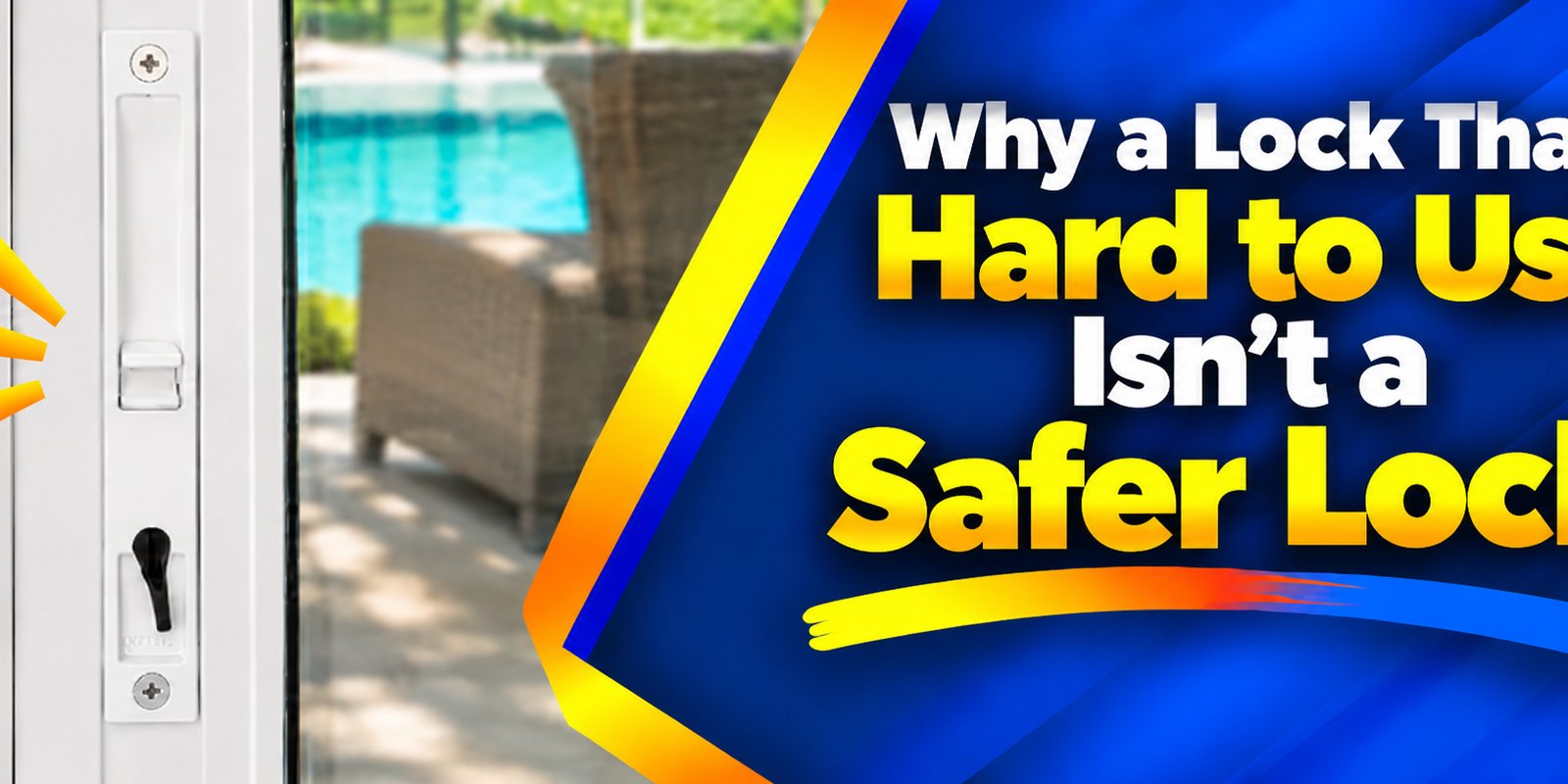

There's an idea a lot of people carry around without thinking about it: if a lock is hard to work, it must be hard to break. Stiff equals strong. Fiddly equals secure.
It's wrong. When it comes to your sliding glass door, an easy-to-use sliding door lock is usually the safer one. Here's why.
What Makes a Sliding Door Lock "Easy to Use"?
An easy-to-use sliding door lock works on the first try with one hand, doesn't make you pinch a tiny tab, and clearly shows whether it's locked. Anyone in the house should be able to work it, from a young child to a grandparent, and it should open fast from inside in an emergency.
That's the standard. Most builder-grade sliding door locks miss on at least two of those points.
Reason 1: Security Only Counts When the Lock Is Used
The strongest lock in the world does nothing if it's open. This is the part that "hard equals safe" gets backwards.
When a lock is stiff, small, or confusing, people find workarounds. They lock it "later." They let the kids leave it open. They stop checking. Vivint lists walking through an unlocked door as one of the most common ways intruders get past a sliding door (Vivint). No tools needed.
An easy lock removes the excuse. If locking up takes one motion, it gets done.
Reason 2: Everyone in Your House Needs to Work It
Think about everyone who uses your sliding door in a typical month: you, your spouse, kids or grandkids, visiting family, a pet sitter, a house cleaner, a neighbor checking on things while you travel.
If even one of them can't lock it, or isn't sure whether they did, the door is only as secure as its least confident user. A lock that's easy for a seven-year-old and an85-year-old is a lock that's secure for everyone.
Reason 3: You May Need to Get Out Fast
This is the reason people forget. Your sliding door isn't just a way in. In a fire or other emergency, it may be your best way out.
Fire safety codes for commercial buildings are built on this idea. NFPA, the organization behind the Life Safety Code, explains that locks on exit doors can't require a key, a tool, or special knowledge or effort to open from the inside, and that releasing devices need an obvious method of operation that works under all lighting conditions (NFPA).
Those rules are written for commercial buildings, not homes. But the logic holds. In the dark, in smoke, or in a panic, you want a lock you can open with one quick motion, not a tiny tab you have to find and pinch.
The same goes for the security bar in your track. It's a great second layer, and police recommend one. Just make sure everyone in the house knows it's there and can lift it out quickly.
Reason 4: A Lock You Can Read Is a Lock You Trust
A lot of builder-grade sliding locks give almost no feedback. The tab barely moves, and locked and almost-locked look the same. So people jiggle the door, walk away, and comeback to check.
A lock with a clear, visible position ends that. You glance at the door, you know, and you go to bed. That's not just convenient. It's how you catch the night someone else forgot.
Easy and Secure Aren't a Trade-Off
The real choice isn't"easy" versus "secure." It's a well-designed lock versus apoorly designed one. A good lock is both.
That's how we approached the LeverGuard™ Lock System:
· Easy: A one-touch lever instead of a stiff vertical slide, designed so kids, seniors, and everyone in between can use it.
· Secure: A fortified die-cast aluminum lock body, engineered for increased resistance to forced entry, with improved lock engagement so it seats fully instead of "sort of" catching.
· Built to last: Tested through 100,000+lock/unlock cycles and backed by a Limited Lifetime Warranty.
LeverGuard™ locks with a lever from inside. No key, no hunting for a small tab in the dark.
Frequently Asked Questions
Is a harder-to-open lock more secure? Not necessarily. Security comes from the strength of the lock body and how fully it engages, not from how hard it is to operate. A hard-to-use lock is more likely to be skipped, which makes the door less secure overall.
What's the safest kind of lock for a family with kids and grandparents? One that anyone in the house can lock with one hand, that clearly shows whenit's locked, and that opens fast from inside. A lever-style lock with afortified lock body checks all three.
The Bottom Line
A lock that's hard to use doesn't keep people out. It keeps people from using it. The safest sliding door lock is the one everyone in your house can lock every night, confirm at a glance, and open in a second when it counts.
Upgrade my lock → Most homeowners install it in anafternoon. Limited Lifetime Warranty.